

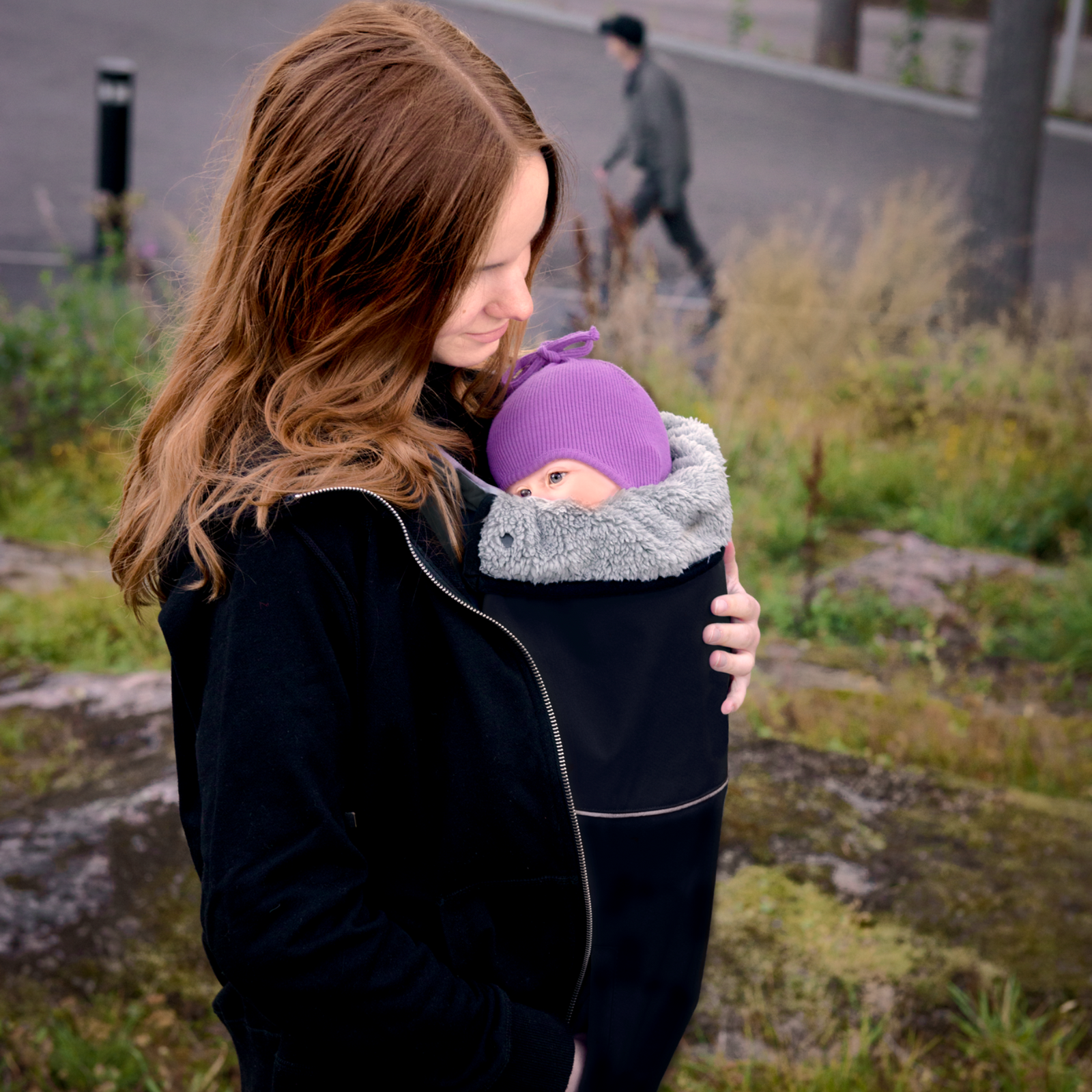








One of the questions we get most frequently is about the right wrap length.
The very best thing would be to try and test it out at a babywearing consultation, but that's not always possible.
Here are some pointers:
In general, the required wrap length depends primarily on two factors: the clothing size of the person carrying, and the desired tying technique.
The age or size of the baby plays no decisive role, as babies tend to grow in the width of the wrap rather than in length.
If more than one person uses the baby wrap, one should orient oneself to the person with the largest clothing size.
Even if it seems tempting to choose the longest wrap length to "be able to tie everything," we would advise against it: if you use a baby wrap that is too long, it is much harder to maintain tension, as you have to pull so much loose fabric through the knot. Moreover, you'll then simply have a lot of excess fabric at the end, which also needs to be stowed away somehow.
Please don't be worried if, as a beginner, the wrap seems a bit short. With more practice and more precise, strand-by-strand tightening of the baby wrap, you can usually gain quite a bit of length.

Front Wrap Cross Carry
The Front Wrap Cross Carry is probably the most commonly used tying method, as it is very easy to learn and suitable from birth.
The standard length for this tying technique is size 6. Slender, smaller wearers may find size 5 sufficient, while sturdier and taller individuals may need size 7.

Simple Rucksack Carry
The simple rucksack carry is a back carry method that is the only back carry technique suitable from birth.
The standard length for this tying technique is size 4. Slender, smaller wearers may find size 3 sufficient, while sturdier and taller individuals may need size 5.

Kangaroo
The Kangaroo tying technique is also suitable from birth. It is a little more difficult to learn than the Front Wrap Cross Carry but then often becomes all the more popular in use. Apart from that, this tying technique is gentler on your pelvic floor compared to the Front Wrap Cross Carry.
The standard length for this tying technique is size 4. Slender, smaller wearers may find size 3 sufficient, while sturdier and taller individuals may need size 5.


Double Hammock
The Double Hammock is a multi-layered back carry method. This type of carry is suitable from about 5-6 months of age.
The standard length for this tying technique is size 7. Slender, smaller wearers may find size 6 sufficient, and even for sturdier and taller individuals, size 7 is usually sufficient.
Our baby wraps, by the way, are usually about 20-30cm longer than stated when they arrive at their new home. This ensures you still have the required length even after many washes, as the fabric always condenses a bit at the beginning.
Of course, there are many more tying methods, both for back carrying and front carrying. If you are interested in a tying method that is not mentioned here and you are unsure about the required length – just ask us, we are happy to help!


